

More Articles...
Early Origins of Trampoline Design
At the end of a trapeze act, performers would exit by landing on the safety net and performing a few additional skills. This led to improvements in the bounce of the nets for circus acts that used only the net. These were called “stage wreckers” due to the high tension required for these frameless systems.
Early Training and In-Ground Systems
Some permanent in-ground units were created to train acrobats, mostly in the USA and Canada.
Modern Trampoline Innovation
George Nissen, a tumbler, wanted to create a more practical unit and is credited as the inventor of folding trampolines as we know them. He began working in his garage. His vision was supported by the engineering work of one of his original business partners, Bob Fenner.
Frame Engineering Evolution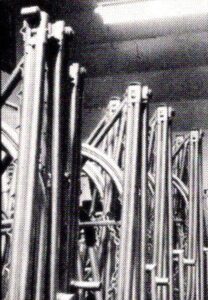
To handle inward spring forces, early frames were made from two round steel tubes that were bent and welded together. A photo from a 1955 Nissen brochure shows this design.
When it was discovered that oval tubing could provide the same strength with less weight and fabrication time, and once production scaled, custom tubing was developed in the size commonly used today. This tubing was ideal for trampolines with 6’ × 12’ beds and was widely copied by other manufacturers.
The Shift to 7 × 14 Competition Frames
In 1966, a larger frame for 7’ × 14’ beds was introduced and used at the 3rd World Trampoline Championships. These trampolines were used without end decks and had 25mm webbing beds. This frame size has remained the competition standard ever since.
The Structural Limitation in Modern Trampoline Frames
However, Nissen used the same sized custom tubing for the larger frame. When each frame dimension increases by 7/6, tubing strength should increase by 1.59 times, and comparable stiffness requires tubing that is 1.26 times larger. That change was not made.
As a result, competition trampoline frames have used undersized tubing ever since. It is simply history.
Modern Performance Considerations
As webbing decreased from 25mm to 4mm, bounce height increased significantly. Using the same steel tubing and frame size from 1966 under these new performance conditions raises valid concerns.
Rebound Products Approach
Rebound Products’ motto is “Relentless Product Evolution.”
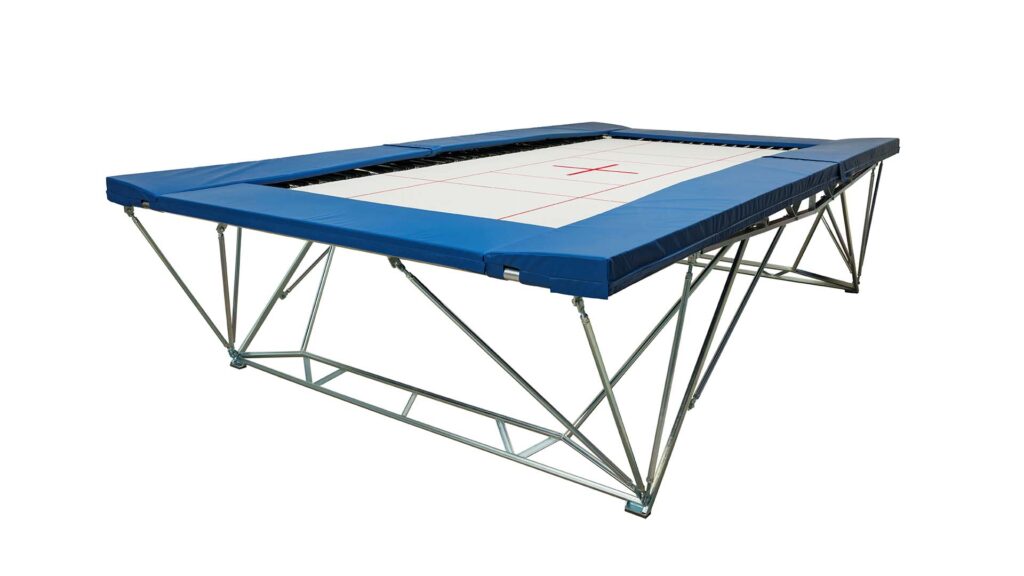
In 2004, Rebound Products began producing non-folding 7’ × 14’ trampolines using large rectangular tubing, resulting in significantly improved strength.
Since 2017, the company has transitioned to custom oval tubing that is 1.4 times larger—surpassing, rather than falling short of, the stiffness of traditional 6’ × 12’ frames.
Choosing the Right Trampoline Frame
Understanding trampoline frame design is essential when evaluating performance, safety, and long-term durability.
If you are comparing trampoline systems or looking for equipment built with modern engineering standards, contact Rebound Products to learn more about current designs and specifications.